
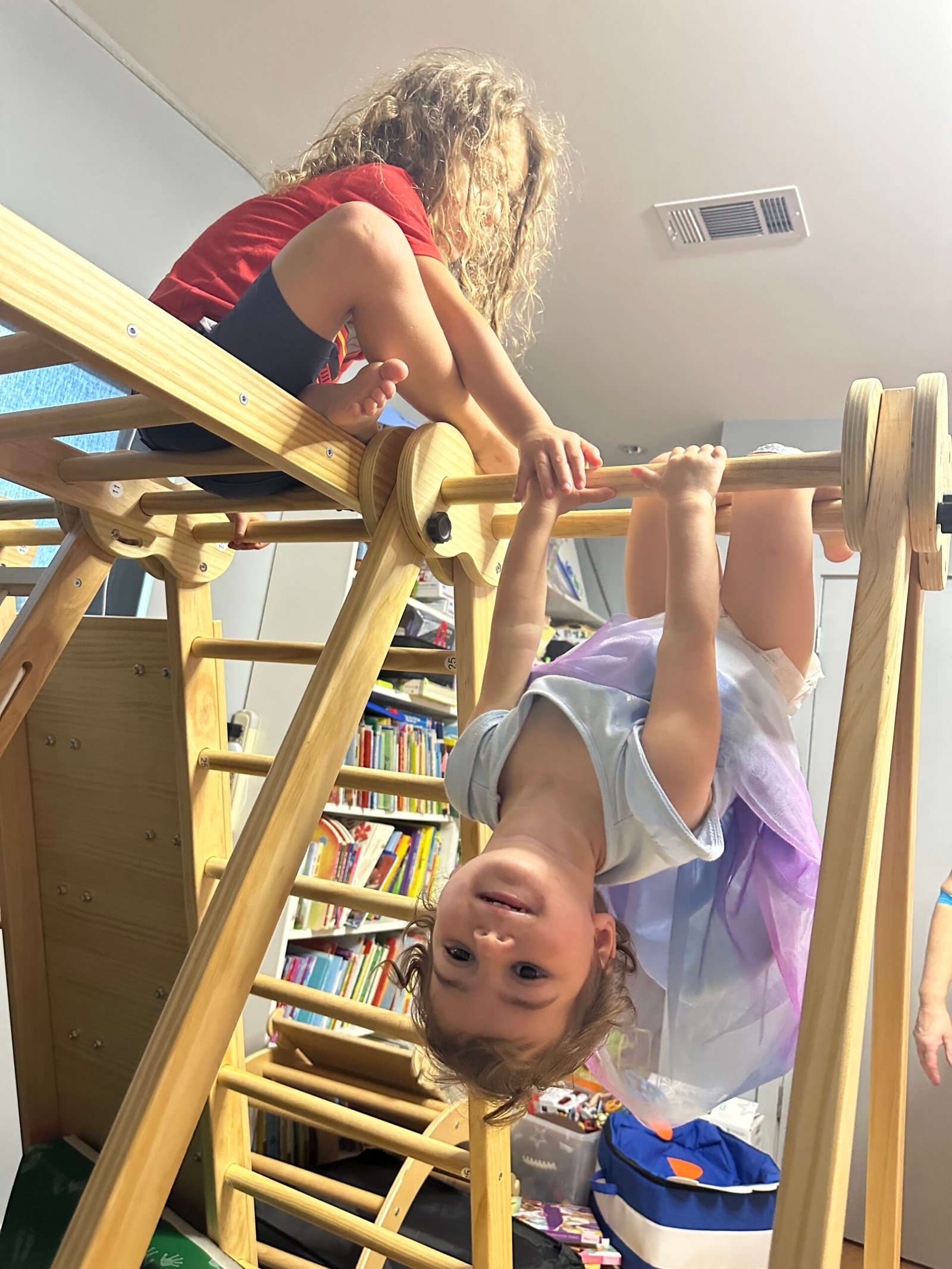
Welcome, adventurous parents and guardians of tiny mountaineers! Are you ready to transform your living space into a pint-sized version of Mount Everest? Buckle up (or should I say, harness up?) because we’re about to explore the wild world of Montessori climbing toys. Get ready to witness your little ones scale new heights of physical development, all while you try not to hyperventilate at the sight of their daring feats!
Why Montessori Climbing Toys? (Because Couch Cushion Forts Are So Last Century)
Before we start assembling your indoor climbing paradise, let’s talk about why Montessori climbing toys are the secret sauce to raising physically capable and confident kids:
- Gross Motor Skill Development: Because “couch potato” shouldn’t be a life goal.
- Balance and Coordination: Preparing them for future tightrope walking careers (or just navigating crowded sidewalks).
- Spatial Awareness: So they stop bumping into everything like tiny, adorable bumper cars.
- Risk Assessment: Teaching them to evaluate challenges safely (instead of just yelling “YOLO!” and jumping).
- Confidence Building: Nothing says “I can conquer the world” like scaling a 3-foot climbing wall.
The Montessori Approach to Physical Activity: More Than Just Running in Circles
In the Montessori world, physical development isn’t just about burning off energy (though that’s a delightful side effect). It’s a holistic approach that integrates mind, body, and spirit. Here’s the method behind the madness:
- Freedom of Movement: Let them climb, crawl, and clamber to their heart’s content (within safe boundaries, of course).
- Self-Directed Activity: They choose when and how to engage with the equipment. It’s like a tiny democracy, but with more climbing.
- Prepared Environment: Carefully designed spaces that invite exploration and challenge. Think “adventure playground” meets “safety inspector’s dream.”
- Mixed Age Groups: Younger kids learn from older ones, older kids reinforce skills by teaching. It’s like a climbing mentorship program!
- Respect for the Child’s Abilities: Trust that they know their limits (while keeping a watchful eye, because, well, they’re still kids).
Types of Montessori Climbing Toys: From Floor to Ceiling (Literally)
Ready to equip your home with climbing toys that would make a mountain goat jealous? Here’s your shopping list for turning your living room into an indoor playground:
1. The Pikler Triangle: The Swiss Army Knife of Climbing Toys
- A simple triangle-shaped climbing frame with rungs.
- Versatile for different ages and climbing abilities.
- Can be used as a climbing frame, fort base, or slide when paired with a board.
- Warning: May also double as an impromptu clothes drying rack for desperate parents.
2. Climbing Arch: For the Budding Acrobat
- A curved structure that can be climbed or used as a bridge.
- Great for developing upper body strength and coordination.
- Can often be folded for storage (or for quickly hiding evidence of your indoor playground from judgmental in-laws).
3. Rock Climbing Wall: Bringing the Outdoors Indoors
- A wall-mounted panel with climbing holds.
- Adjustable difficulty by changing hold positions.
- Excellent for building strength, problem-solving skills, and spatial awareness.
- Bonus: Doubles as an avant-garde art installation when not in use.
4. Balance Beam: For Aspiring Gymnasts (and Tightrope Walkers)
- A low, narrow beam for walking and balancing.
- Improves balance, coordination, and concentration.
- Can be used in combination with other equipment for obstacle courses.
- Also useful for parents practicing their “walking the line” sobriety tests after a long day of childcare.
5. Climbing Rope: Channeling Their Inner Tarzan
- A sturdy rope hung from a secure point (please consult a professional for installation).
- Builds upper body strength and grip.
- Great for sensory input and proprioception.
- Not to be confused with the “Mom’s last nerve” that children seem intent on climbing.
Setting Up Your Indoor Climbing Paradise: Safety First, Fun Second (But It’s a Close Race)
Before you start assembling your indoor climbing wonderland, keep these safety tips in mind:
- Padding, Padding, and More Padding:
- Invest in high-quality foam mats to place under and around climbing equipment.
- Consider wall padding for areas near climbing walls.
- Remember: The goal is to cushion falls, not prevent them entirely. Kids need to learn from minor tumbles.
- Secure Anchoring:
- Ensure all equipment is properly anchored and stable.
- Regularly check for loose bolts, worn ropes, or any signs of wear and tear.
- If in doubt, consult a professional. Your DIY skills might be great, but let’s leave the serious stuff to the experts.
- Age-Appropriate Equipment:
- Choose climbing toys suitable for your child’s age and ability level.
- Provide a range of challenges to keep things interesting as they grow.
- Remember: What’s challenging for a 2-year-old might be a warm-up for a 5-year-old.
- Clear Rules and Supervision:
- Establish clear rules for using the equipment.
- Always supervise climbing activities, especially for younger children.
- Teach proper techniques for climbing, dismounting, and falling safely.
- Regular Maintenance:
- Inspect equipment regularly for any damage or wear.
- Clean surfaces to prevent slipping hazards.
- Replace or repair any damaged parts immediately.
Montessori Climbing Activities: Because “Sit Still” is Not in a Child’s Vocabulary
Now that you’ve got your climbing equipment set up, here are some Montessori-inspired activities to maximize the fun and learning:
1. Obstacle Course Challenge
- Set up a course using various climbing equipment.
- Encourage children to plan their route before starting.
- Time trials can add an extra element of excitement for older kids.
- Warning: May result in children timing your daily activities. “Mom, new record for loading the dishwasher!”
2. Color-Coded Climbing
- Assign colors to different holds or rungs.
- Create “routes” using specific color sequences.
- Great for cognitive development and problem-solving.
- Side effect: Children may start color-coding everything in the house. Even the dog.
3. Blindfolded Balance Beam
- Have children try to walk a balance beam with eyes closed (with spotting, of course).
- Excellent for developing proprioception and trust.
- Start with sitting and crawling before progressing to walking.
- Bonus: Great practice for navigating to the bathroom in the middle of the night without waking the whole house.
4. Storytelling Climb
- Create a story where different parts of the climbing equipment represent story elements.
- Have children act out the story as they climb.
- Encourages creativity and language development alongside physical skills.
- Prepare for some very… interesting plot twists. “And then the princess climbed the dragon instead of fighting it!”
The Benefits Breakdown: Why Your Living Room Jungle Gym is Worth the Sacrifice of Space
Still not convinced that turning your home into a mini adventure park is worth it? Let’s break down the benefits:
- Physical Strength and Endurance:
- Builds muscle strength, particularly in the upper body and core.
- Improves cardiovascular endurance.
- Develops fine motor skills through gripping and maneuvering.
- Cognitive Development:
- Enhances problem-solving skills as kids navigate climbing challenges.
- Improves spatial awareness and mental mapping.
- Boosts concentration and focus.
- Emotional Growth:
- Builds self-confidence as children master new skills.
- Teaches resilience through overcoming obstacles.
- Develops a healthy relationship with risk-taking.
- Social Skills:
- Encourages cooperation when used in group play.
- Teaches turn-taking and patience.
- Provides opportunities for leadership and mentoring among mixed age groups.
- Sensory Integration:
- Provides vital proprioceptive input, helping children understand where their body is in space.
- Offers vestibular stimulation, crucial for balance and spatial orientation.
- Engages multiple senses simultaneously, promoting sensory integration.
The Do’s and Don’ts of Montessori Climbing: A Cheat Sheet for Perplexed Parents
Before you release your little spider-monkeys onto their new climbing paradise, keep these tips in mind:
Do:
- Allow for independent exploration. Resist the urge to constantly assist or direct.
- Encourage problem-solving. “How else could you climb that?” is more valuable than “Do it this way.”
- Celebrate efforts, not just successes. The journey is as important as reaching the top!
- Rotate or reconfigure equipment regularly to maintain interest and provide new challenges.
- Use climbing time as an opportunity for connection. Join in the fun when invited!
Don’t:
- Hover anxiously. Your nervousness can transfer to your child.
- Force a child to climb if they’re not comfortable. Encouragement is good, pressure is not.
- Neglect safety checks. Regular equipment inspections are crucial.
- Forget to teach proper falling techniques. Knowing how to fall safely is as important as knowing how to climb.
- Underestimate your child’s abilities. They might surprise you with what they can do!
The Final Ascent: Embracing the Climb
Congratulations! You’re now equipped to turn your home into a Montessori-inspired climbing paradise. Remember, the goal isn’t to raise the next Alex Honnold (although if that happens, we expect tickets to the premiere of their death-defying documentary). The real aim is to foster physical confidence, problem-solving skills, and a love for active play that will serve your child well throughout their life.
So move aside the coffee table, roll out those mats, and get ready to watch your little ones reach new heights (literally). Who knows? You might even find yourself joining in on the fun. After all, who says climbing is just for kids?
Now, if you’ll excuse me, I have a date with a Pikler triangle and a 4-year-old who’s convinced she’s training for the Olympics. Wish me luck – I may need it more than she does!
Remember, in the grand adventure of parenting, sometimes you need to climb a few mountains (or at least a few indoor climbing frames) to reach those peak moments of childhood development. So harness up, spot your little climbers, and enjoy the ascent. The view from the top – watching your child grow, learn, and conquer challenges – is absolutely worth the climb.